AI-Powered Lead Generation Pipeline
An end-to-end B2B lead generation and outreach pipeline in n8n, made of 11 connected workflows. It takes a client intake and moves qualified prospects through sourcing, enrichment, verification, CRM sync, outreach, reply handling and reporting with minimal manual intervention.
20+
marketing hours saved per week
across 11 connected workflows, from client intake to weekly ICP insights
- Date
- Sep – Oct 2026
- Associated with
- AI Agency Lab (freelance)
- My role
- Architecture, build, testing
- Core platform
- n8n · Airtable · HubSpot
Context
B2B outbound for agency clients. Each new client needs a defined Ideal Customer Profile, a sourced and verified prospect list, outreach running through their CRM, and a way to see what's working.
The Challenge
Done by hand, that work is spread across databases, enrichment tools, spreadsheets, the CRM and the outreach platform. Records get processed twice, data goes stale between tools, provider credits are spent unevenly, and replies have to be triaged manually before sales can act.
My Role
I designed the architecture and built the pipeline in n8n: the Airtable data model, the provider integrations, the AI steps, the reliability safeguards, and the reporting.
The Approach
- Split the process into 11 connected workflows so each stage can run, fail and retry on its own.
- Make Airtable the operational data layer, with record status locks so nothing is processed twice.
- Use rules where the logic is clear, and AI where judgment helps: ICP ranking, fit checks, openers, reply classification and weekly insights.
- Put every paid provider behind fallbacks, caching and per-run credit budgets.
Before and After
Before
- Prospect research spread across databases and spreadsheets.
- Data copied by hand between enrichment tools, the CRM and the outreach platform.
- Records at risk of being processed twice, and provider credits spent unevenly.
- Replies triaged manually before sales could act.
After
- 20+ marketing hours saved per week.
- One pipeline from client intake to sales handoff, in 11 connected workflows.
- Every record tracked in Airtable, with status locks that stop double processing.
- Verified contacts synced to HubSpot and enrolled in Reply.io automatically, with credit budgets and caching.
- Replies classified, with deals, tasks and Slack alerts created for sales; daily KPIs and weekly ICP insights.
What I Built
System architecture, read left to right in four phases. On smaller screens the phases stack top to bottom.
-
Phase 1 · Define
01 Intake
Client intake starts the run via webhook.
Webhooks02 ICP
Claude analyses the client's website and best customers to create and rank the Ideal Customer Profile.
Claude -
Phase 2 · Source & qualify
03 Company sourcing
Companies from Apollo, Google Maps, web search and LinkedIn data.
ApolloGoogle MapsWeb searchLinkedIn data04 Enrichment
Finds decision-makers and enriches contacts, falling back across providers.
ApolloHunterRocketReachFirecrawlTavilyApify05 Verification
Email addresses are verified before anything is sent.
06 Scoring
Rules plus AI-assisted fit checks decide who moves forward.
-
Phase 3 · Engage
07 HubSpot
Approved leads sync to the CRM.
HubSpot08 Outreach
Leads enrol in email and LinkedIn sequences with AI-assisted personalised openers.
Reply.io09 Reply handling
Replies are classified; unsubscribes are handled automatically.
-
Phase 4 · Hand off & learn
10 Sales handoff
Deals and tasks are created for the sales team, with Slack alerts.
HubSpotSlack11 Reporting
Daily KPIs go to Looker Studio. A weekly AI insights report suggests ICP improvements.
Looker Studio
Operational data layer
Airtable holds every record and its status across all 11 workflows.
Reliability layer — applies to every stage
- Central error handling
- Record status locks
- API response caching
- Per-run credit budgets
- Suppression lists
- Provider fallback
- Throttling
- Retries
- Logging
- Health checks
From the build
Screenshots of the n8n workflows. Select any image to open it full size.
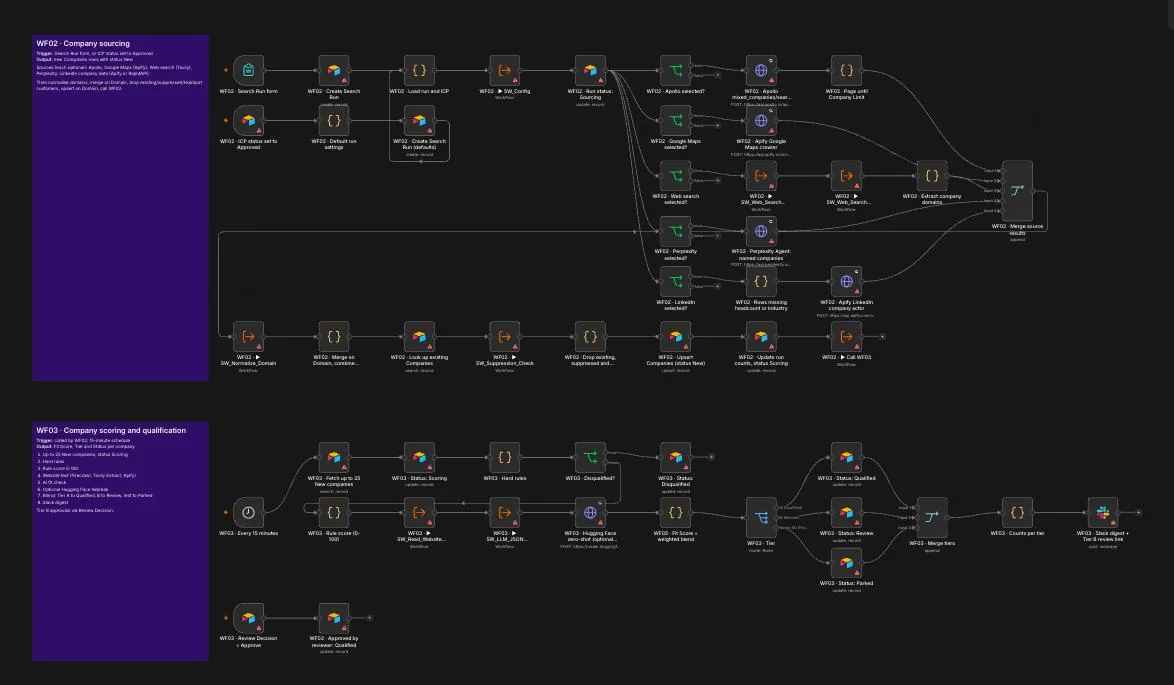 (opens full size in a new tab)
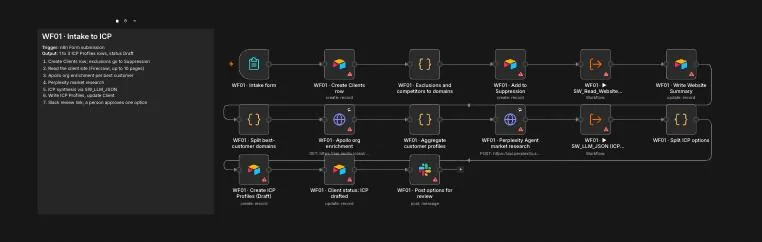 (opens full size in a new tab)
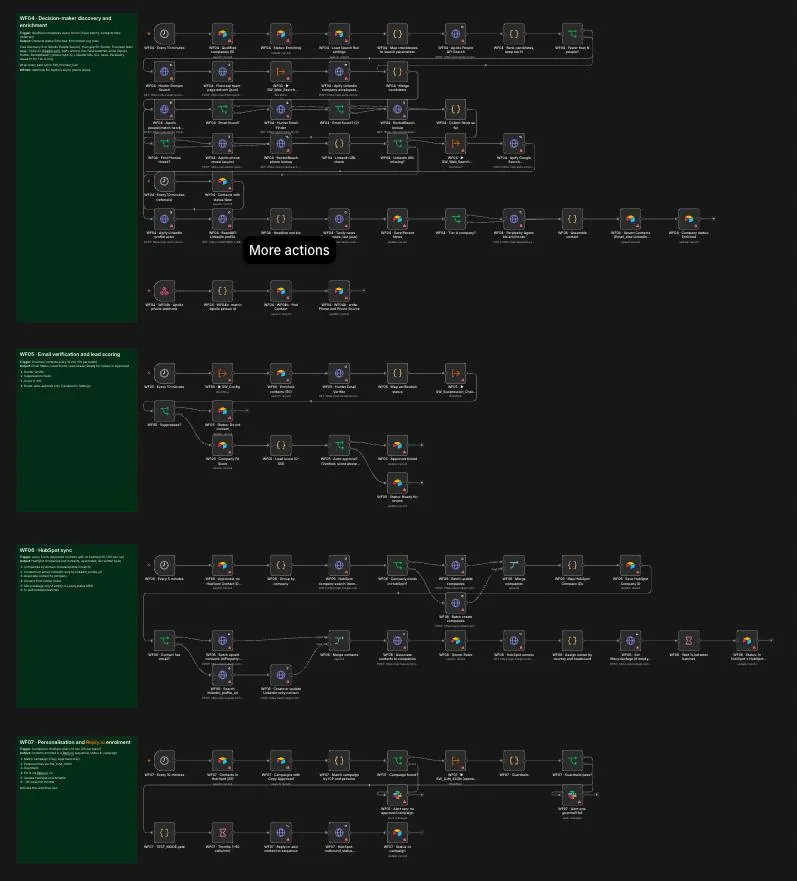 (opens full size in a new tab)
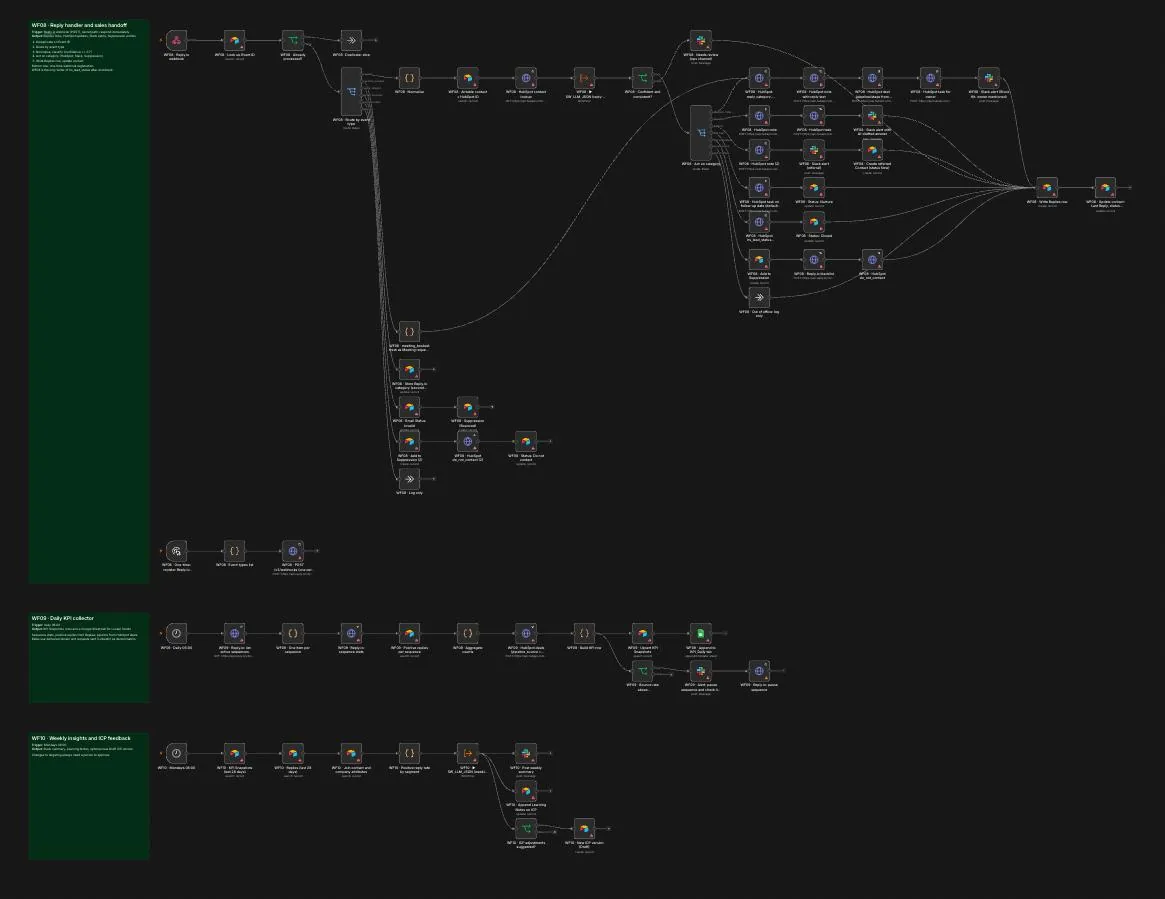 (opens full size in a new tab)
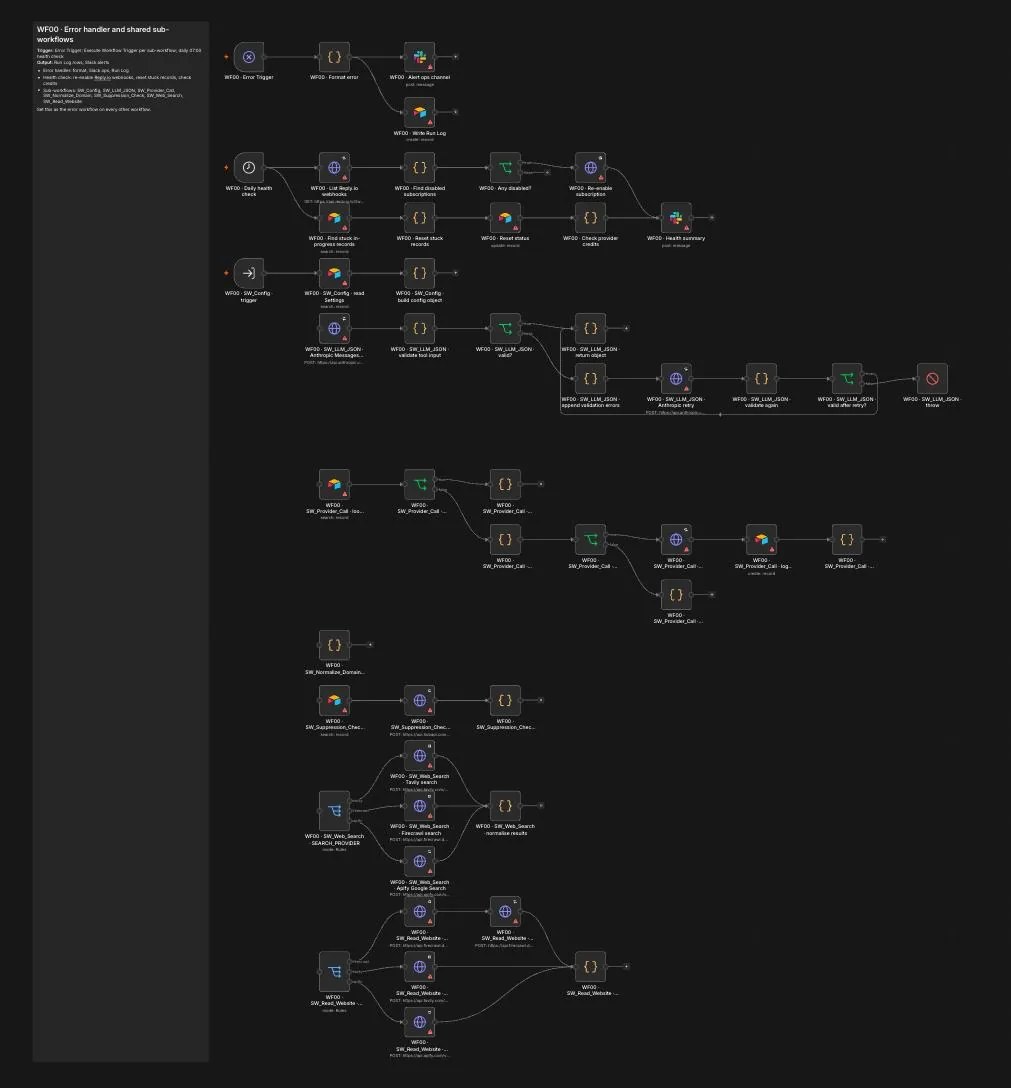 (opens full size in a new tab)
Why the safeguards matter
No double processing
Record status locks stop two runs from enriching or contacting the same lead.
Controlled spend
Per-run credit budgets, caching and throttling keep paid API usage predictable.
Graceful failure
Provider fallbacks, retries and central error handling keep one outage from stopping the pipeline.
Safe outreach
Verification, suppression lists and automatic unsubscribe handling protect sender reputation.
Outcome
20+
Marketing hours saved per week
One pipeline of 11 connected workflows now covers what used to be separate manual steps:
- Prospects sourced, enriched, verified and scored before they reach the CRM.
- Outreach enrolled automatically with personalised openers.
- Replies classified, with deals, tasks and Slack alerts created for sales.
- Daily KPIs in Looker Studio and a weekly AI report on where the ICP could improve.
Technology
- Orchestration & data
- n8n · Airtable · Webhooks
- CRM & outreach
- HubSpot · Reply.io · Slack
- AI & research
- Claude · Perplexity · Tavily
- Sourcing & enrichment
- Apollo · Hunter · RocketReach · Firecrawl · Apify · RapidAPI
- Reporting
- Looker Studio
Key takeaway
The value isn't any single tool. It's that every stage knows a record's status, what processing it will cost, and what to do when a provider fails — which is what makes a pipeline like this something a team can operate, not just demo.
Need a system like this?
Hiring for marketing technology, or have a lead-generation process to fix.